(from Wikipedia)
A silver object that is to be sold commercially is, in most countries, stamped with one or more silver hallmarks indicating the purity of the silver, the mark of the manufacturer or silversmith, and other (optional) markings to indicate date of manufacture and additional information about the piece. In some countries, the testing of silver objects and marking of purity is controlled by an assayer’s office.
Hallmarks are applied with a hammer and punch, a process that leaves sharp edges and spurs of metal. Therefore, hallmarking is generally done before the piece goes for its final polishing.
Hallmarks on British sterling (L-R): Crown signifying city of Sheffield, lion passant, Letter n of a style dating piece to 1905, maker’s insignia for Walker & Hall.
The hallmark for sterling silver varies from nation to nation, often using distinctive historic symbols, although Dutch and UK Assay offices no longer strike their traditional hallmarks exclusively in their own territories and undertake assay in other countries using marks that are the same as those used domestically.
United Kingdom and Ireland
One of the most highly structured hallmarking systems in the world is that of the United Kingdom, (Scotland, England, Wales and Northern Ireland), and Ireland. These five nations have, historically, provided a wealth of information about a piece through their series of applied punches. It should be noted that since 2015 visually identical UK Hallmarks are being struck in India and Italy by sub-offices of Birmingham & Sheffield Assay Offices respectively.
A stamp indicating the purity of the silver is called the assayer’s mark. The mark for silver meeting the sterling standard of purity is the Lion Passant, but there have been other variations over the years, most notably the mark indicating Britannia purity. The Britannia standard was obligatory in Britain between 1697 and 1720 to try to help prevent British sterling silver coins from being melted to make silver plate. It became an optional standard thereafter, and in the United Kingdom and Ireland is now denoted by the millesimal fineness hallmark “958”, with the symbol of Britannia being applied optionally. The purity mark for Irish silver is the harp crowned.
The date marks is a letter indicating the exact year in which the piece was made. The typeface, whether the letter is uppercase or lowercase, and even the shape inside which the letter is stamped, must all be taken together to determine the year.
The city mark no longer indicates the city in which the piece was assayed, or that the item was assayed in the UK. A Legislative Reform Order (LRO) came into law on 8 February 2013 giving UK Assay Offices the legal right to strike hallmarks outside of UK territory. Since July 2016 Birmingham Assay Office have been striking Birmingham Hallmarks in Mumbai, India and there are proposals for further offshore marking centers. In March 2018 the British Hallmarking Council announced that in future, items assayed and marked offshore must be distinguishable from those assayed in the UK. An additional mark to indicate that an item was assayed outside the UK is likely to be introduced in 2018. Sheffield Assay have a sub-office in Malpensa, Italy. London and Edinburgh Assay Offices are the only two Assay offices exclusively striking hallmarks in the UK.
Shows the hallmarks for two pieces of English silver (from the workshops of George Adams (1842) and Joseph & Albert Savory (1838)) each with a tally mark added (the letter B on one and a small dot on the other). Both pieces also have a Duty Mark (Queen Victoria).
Each silver maker has his or her own, unique maker’s mark. This hallmark is usually a set of initials inside an escutcheon. The Legislative Reform Order (LRO) which came into law on 8 February 2013 also changed the requirements for sponsor marks, allowing logos to be used for the first time, as long as they provide the required traceability.
Irish silver also contains the image of Hibernia. This mark was introduced in 1730, and is still in use today.
One of the most common inquiries at antique shows often has to do with authenticity: How do you know whether or not something is made of real silver? Collectors aren’t always looking for pure sterling silver, per se, but they should be able to know the value and composition of the pieces they’re buying. Most of the time, you can find the information you’re looking for by simply taking a closer look at the teaspoon, fish fork, ice cream saw, or cheese spoon that you’re eyeing. More often than not, you can find an indented mark (or a series of marks) that can tell you a lot about the item: what it’s made of, where it was made, when, and by whom.
The Five Most Popular Silver Varieties
You can find many different kinds of silver in the marketplace today. Some of the oldest American silver is “coin,” which contains at least 89.2 percent of silver if it was made between 1792 to 1837, an amount set by the U.S. Mint after the American Revolution—which rose to 90 percent in the years after 1837. Sterling, on the other hand, must be at least 92.5 percent silver. This standard—92.5 parts pure silver to 7.5 parts copper alloy, which strengthens softer silver—was established by the English during the 12th century and later adopted by most of the silver-making world, including the United States in 1868. Many people think of coin as much less valuable than sterling, but it has only about two percent less silver and, in some rare cases, may even contain more.
Silver plate is a coating of pure silver on a base metal such as copper or nickel silver (an alloy of nickel, copper, and zinc) and was developed later than sterling or coin, but various forms date to the 18th century. Electroplating processes were invented in England in the 1830s and 1840s; this method is still used today. “Hotel” silver is a form of electroplate that was manufactured for use in trains, on ships, in restaurants, and hotels.
Certain alloys, referred to as Venetian silver and Nevada silver, consist of nickel and silver. Although they’re solid metal rather than plated, they contain less silver than sterling pieces. These lower-grade compounds are less expensive than silver-plated items, but don’t polish up as easily.
Common Silver Marks
England’s system of hallmarks—a variety of official emblems stamped on silver to illustrate its purity—is one of the oldest and most detailed. Laws dating to the 14th century established strict requirements for marking silver; the first emblem was a crowned lion’s head to certify sterling, which are all stamped in a row. If you find a lion on your piece, you’ll immediately know that it’s come from Britain. Symbols for where it was made include an anchor for Birmingham and a crown for Sheffield (in 1975, it changed to a rose). Another mark is the head of the reigning monarch. And a letter stamp tells you when it was made: Each year is assigned one letter of the alphabet, and a new cycle starts with a different font. Until the 1500s, the symbol for the silversmith was often a plant or an animal suggesting the family name. Today, initials are used.
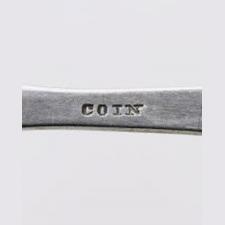
American marks weren’t enforced as systematically and were therefore never as elaborate. Early coin silver was often marked with the maker’s name, and nothing else; sometimes it doesn’t show even that. Eventually, manufacturers also started using the word “coin.” But after the Civil War, silversmiths continued to stamp their own names on the back, along with the word “sterling” or the number 92.5 or 925, all of which indicate sterling quality. Some companies used symbols as a commercial logo. The Gorham company’s mark was a row of three emblems: a lion (for sterling), an anchor (for its base in Rhode Island), and a “G” (its initial).
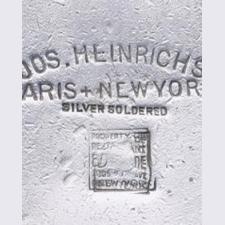
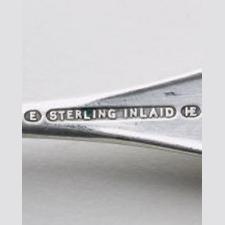
Silver plate has its own codes in the United States and abroad. The maker or company name is usually stamped on the back of the piece along with an indication that it’s plated: In America, for instance, these marks are A1, AA, EP, or the full phrases “sterling inlaid”, or “silver soldered.” According to industry standards, AA has one-third as much silver used in plating as does A1 pieces. It’s important to note that seeing the word “sterling” doesn’t mean it’s automatically a true sterling silver piece.
American Solid Silver
Early U.S. silver is often simply marked “coin” .
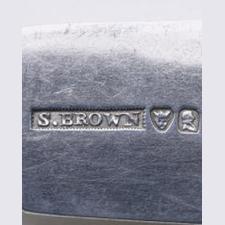
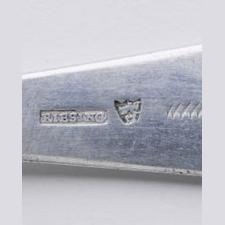
“S. Brown” manufactured this sterling piece, as indicated by the stamp, but the hallmarks that follow are actually bogus, as they imitate the English system because of its cachet in the marketplace.
On the back of this sterling fork, the lion, anchor, and “G” identify the Gorham company.
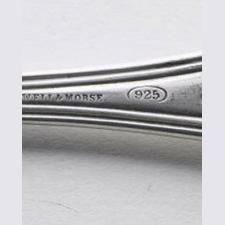
On a spoon handle marked with the maker Crosby, Honnewell, and Morse is the number 925—which is a code for sterling.
Nonsterling American Marks
A wide range of symbols were used by U.S. manufacturers to designate silver plating and solid lower-grade alloys in the marketplace.
A1 and AA: These discreet markings indicate the number of ounces of pure silver used in the plating. There’s two ounces per gross of teaspoons for A1, and three ounces for AA.
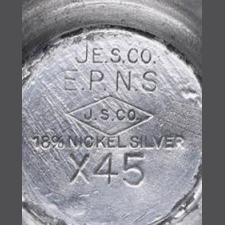
EPNS: Electroplated nickel silver, commonly known as “EPNS”, is an alloy of nickel, copper, and zinc that’s covered with a layer of pure silver in an electrochemical process. Nickel’s resemblance to silver helps disguise any worn spots that develop over time.
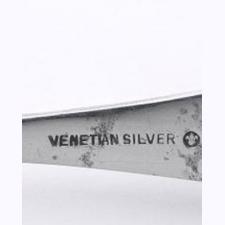
Venetian Silver: This flatware is made of a blend of silver and base metals is solid, not plated, but has a much lower silver content than either sterling or coin.
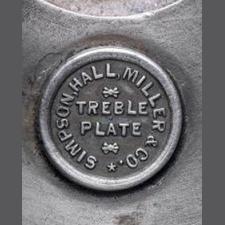
Treble Plate: This stamp means that three layers of silver plating were applied to a base metal during manufacturing.
Hotel: A few big companies, such as Oneida, produced large orders of silver plate for hotels in the 19th century.
Silver Soldered: This is another way of signifying that the piece is silver-plated.
Sterling Inlaid: Advertising itself as sterling, this mark for a silver plate piece can be deceptive and misleading.
International Silver
Experts at Sotheby’s auction house report that markings vary by country—and submissions from potential auctioneers require considerable research just to determine whether a piece is sterling. We’re sharing a few examples of confounding silver marks from across the globe below.
Early Asian sterling is marked with Asian characters. This sterling spoon from the former British colony of Hong Kong, however, is obviously geared toward English speakers.
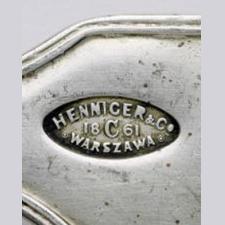
This piece from Warsaw, Poland proclaims its origin—but says nothing about its silver content.
On the right, the slash marks on the back of this spoon identify the piece as German, and another clue is the shield with the eagle.
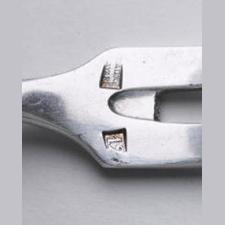
On the other hand, 90 is a standard marking for silver plate, and this is located on the bottom of the spoon’s handle.
The number 800 (bottom) is a common notation for silver in Russia. The one pictured, however, is a German .800 silver mark, depicting a crown and crescent moon along with the maker’s mark of WTB—for manufacturer Wilhelm Binder.
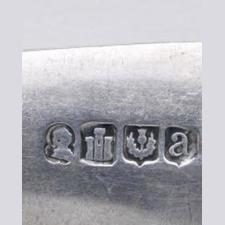
This sterling spoon bears the hallmarks for Scotland, which is the thistle, and for Edinburgh, marked using the castle, as well as the profile of George III.
The information in these Italian examples is hard to decipher: IAB is a signifier for pure sterling, although not all Italian sterling carries that mark.
French silver almost always has marks placed on the top of the piece because tables are set with bowls of spoons and tines of forks facing downward.
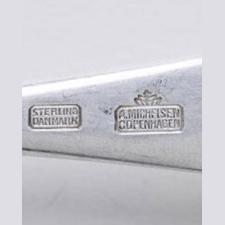
These straightforward marks on this piece of Danish silver identify that it’s sterling, it was made in Copenhagen, and the silversmith, H. Nils.
 |
 |
 |
 |
|
 |
 |
 |
 |
|
 |
 |
 |
 |
 |
|